
|
Nelson Rei Bernardino
Centro de Física Teórica e Computacional
Instituto de Investigação Interdisciplinar
Av. Prof. Gama Pinto, 2
P-1649-003 Lisboa
Portugal
Room: A3-03
Phone: +351 21 790 4971 (internal: 34371)
Fax: +351 21 795 4288
E-mail: nelsonrb[at]cii.fc.ul.pt
|
Home
Research
Publications
CV
Downloads
|
Wetting Phenomena
Fenómenos de Molhagem
 The study of wetting phenomena refers to the study of what happens when a liquid is in contact with a solid substrate. If a liquid like "dislikes" a solid it will tend to form droplets with the minimum contact possible with the solid. If the liquid "likes" a solid it will spread and cover as much as possible of the solid. The study of wetting phenomena refers to the study of what happens when a liquid is in contact with a solid substrate. If a liquid like "dislikes" a solid it will tend to form droplets with the minimum contact possible with the solid. If the liquid "likes" a solid it will spread and cover as much as possible of the solid.
The wetting behaviour depends on the molecular forces, temperature, pressure, etc. It also depends on the substrate chemistry and geometry. A very active area of research is the wetting of rough substrates, with a recent hype on superhydrophobic surfaces.
|
Liquid Crystals
Cristais Líquidos
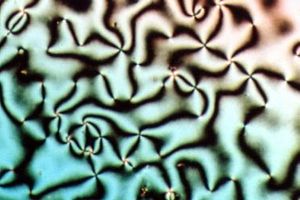 At the CFTC I will be looking into wetting phenomena of liquid crystals. These have orientational degrees of freedom, that bring topological defects into the phenomenology. I plan to use methods similar to the ones we used to study wetting transitions to study effective interactions between surfaces due to the liquid crystal and the effects of thermal fluctuations on these. At the CFTC I will be looking into wetting phenomena of liquid crystals. These have orientational degrees of freedom, that bring topological defects into the phenomenology. I plan to use methods similar to the ones we used to study wetting transitions to study effective interactions between surfaces due to the liquid crystal and the effects of thermal fluctuations on these.
|
Wetting of Hairy Surfaces
Molhagem de Superfícies com Cabelos
 The picture on the left is a drop of water on a leaf of a Lady's Mantle. The leafs of this plant are covered with hidrophilic hairs so the water was not supposed to form spherical droplets that don't even touch the bottom of the leaf. The picture on the left is a drop of water on a leaf of a Lady's Mantle. The leafs of this plant are covered with hidrophilic hairs so the water was not supposed to form spherical droplets that don't even touch the bottom of the leaf.
Otten and Herminghaus sugested that this was due to the elasticity of the hairs. We showed that it is in fact due to contact line pinning.
To know more see the seminar: Wetting of Surfaces Covered by Elastic Hairs.
See also the movies: drop and interface on a leaf of a Lady's Mantle.
|
Wetting Transitions
Transições de Molhagem
 A liquid can change from a state where it does not wet a solid to a state where it wets it completely (contact angle = 0): a wetting transition. A liquid can change from a state where it does not wet a solid to a state where it wets it completely (contact angle = 0): a wetting transition.
When all the intermolecular forces are short ranged the theoretical description of this transition was known to be in disagreement with simulations since the 80s! We showed that this is due to nonlocal effects, as described by the diagram in the left.
To know more have a look at this paper. Also check the material under Wetting Transitions in the Downloads page.
If you really want to know all the details check papers [2-7] in the Publications page or my PhD Thesis.
|
Interested?
Interessado?
There are positions available for students, PhDs and postdocs at CFTC. Send me an email: nelsonrb[at]cii.fc.ul.pt.
|